

June 2, 2026
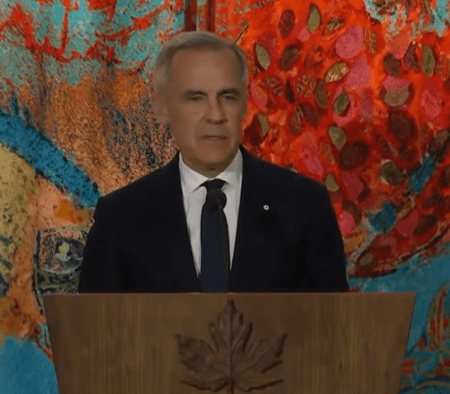
TORONTO – After B’nai Brith Canada called on Mark Carney, the Prime Minister, for months, to address the Jewish community directly about the national crisis of antisemitism, he has finally done so.
That the Prime Minister chose to address the community directly is significant, and his acknowledgment that Jewish Canadians are being disproportionately targeted is important.
But amid an unprecedented, national crisis of antisemitism, when Canada’s Jewish community is facing the worst wave of antisemitism in generations, acknowledgment without decisive action is not enough.
NOT AN AWARENESS PROBLEM
“This was an opportunity for the Prime Minister to meet the moment,“ said Simon Wolle, B’nai Brith Canada’s Chief Executive Officer, who attended the announcement.
“Instead, Canadians heard a speech that described the problem more than it confronted it. The Jewish community did not require another acknowledgment that antisemitism is raging across the country, we needed a plan proportional to the scale of the crisis.
“Canada is not facing an antisemitism awareness problem. Canada has an antisemitism problem. The country has been poisoned with Jew hatred and we need a remedy.”
CANADA’S CIVIC COMPACT IS FAILING JEWISH CANADIANS
Since the Hamas-led terrorist attacks on Israel during Oct. 7, 2023, antisemitism has become normalized in Canada. The severity of the incidents of hate afflicting Jewish Canadians today would have been unimaginable only a few years ago.
Jewish schools and synagogues have been repeatedly targeted with gunfire, Jewish Canadians have been violently assaulted, Jewish students have been harassed and intimidated on campuses, and Jewish businesses have been vandalized.
In his remarks, the Prime Minister correctly observed that Canada’s civic compact is failing Jewish Canadians.
“The reality is even more severe,” Wolle said. “For many Jewish Canadians, that civic compact has already failed. The institutions that were supposed to protect them have too often looked away. The systems that were supposed to respond have too often failed. The consequences are being felt by Jewish communities from coast to coast, every single day.”
STRONGER RESPONSE NEEDED
While the Prime Minister reiterated recent legislative initiatives and investments the Government has undertaken to tackle hate in Canada, he neither acknowledged the full scope of the systemic failures that have allowed antisemitism to flourish, nor identified those responsible for inciting and fomenting antisemitism across the country.
Absent was a clear commitment to mobilize all levels of government, law enforcement, prosecutors, security agencies, educational institutions, and civil society around a coordinated national response. Absent, too, were immediate measures capable of restoring confidence among Jewish Canadians that their government fully understands the severity of what is happening.
“Our children are no safer today than they were yesterday. Threats to our communities and institutions remain equally unchecked today as they did yesterday.
“The Prime Minister’s expressed support for the Jewish community is noted and welcomed, as was his announcement that the Special Advisory Council on Rights, Equality and Inclusion would commence its work by focusing on antisemitism.“
To that end, the Prime Minister directed the Council to review the scale, scope and drivers of antisemitism in Canada, as well as to institute a “whole of Government approach”
“Both are things B’nai Brith Canada has called upon the Government to prioritize,” Wolle said. “However, one must question the capacity and authority of this body to do so in a meaningful fashion. The Council lacks the mandate and expertise to lead the fight against antisemitism in Canada.
“We don’t see a council as a breakthrough, especially one that has taken months to convene.”
ADDRESS CONTEMPORARY ANTISEMITISM
A serious strategy to combat antisemitism must also confront the reality that antisemitism has evolved, and that the historical links between Canada’s Jews and Israel cannot be ignored.
Although criticism of any government is legitimate, contemporary antisemitism increasingly manifesting through the demonization of Zionism, the denial of Jewish self-determination, and the application of standards to the Jewish state which are not applied to any other nation.
“Antizionist manifestations of antisemitism have become increasingly legitimized and normalized,” Wolle said. “A government cannot successfully fight antisemitism while refusing to confront one of its most prevalent contemporary forms.”
FREEDOM IS NOT A SUICIDE PACT
B’nai Brith Canada also rejects the increasingly common notion that hatred should be tolerated in the name of fundamental freedoms.
“Freedom is not a suicide pact; we cannot tolerate intolerance,” Wolle said. “Canadian liberties were never intended to protect intimidation, harassment, violence, the glorification of terrorism, or the targeting of communities because of who they are. The defense of freedom requires the defense of the values that make freedom possible.”
The Government must also address the ideological and organizational infrastructure driving radicalization and hatred.
“We cannot continue cutting the branches while ignoring the roots,” Wolle said. “The head of the snake must be addressed. Any serious effort to combat antisemitism must include confronting the extremist movements, networks, financiers, and organizations across the ideological spectrum that spread hatred, glorify terrorism, and radicalize individuals against Jews and against Canadian values.”
B’NAI BRITH CANADA’S RECOMMENDATIONS
B’nai Brith Canada will continue to call for a comprehensive review of extremist entities operating in Canada or influencing Canadians, including organizations and affiliates linked to movements such as the Muslim Brotherhood. Where the evidence supports their listing as terrorist entities, our Government must immediately undertake to do so.
The organization is also calling on the Federal Government to:
- Establish a National Emergency Task Force on Antisemitism. This must include stakeholders from law enforcement and all levels of government to ensure a comprehensive response to the antisemitism endangering Canada’s Jewish communities;
- Establish a commission of inquiry, with powers as well as a scope and mandate similar to that of a Royal Commission, to get at the root causes of the antisemitism plaguing Canadian society;
- Treat violent attacks against Jewish institutions as matters of national security and, where appropriate, acts of domestic terrorism;
- Fully implement the International Holocaust Remembrance Alliance (IHRA) working definition of antisemitism throughout the Federal Government;
- Use every available legal mechanism to investigate, prosecute, remove, or deport non-citizens who support terrorism, engage in hate-motivated criminality, incite violence, or threaten public safety;
- Strengthen immigration screening and enforcement to ensure newcomers embrace the democratic values, pluralism, equality, and rule of law that define Canada;
- Withhold Federal funding from universities and publicly funded institutions which neither protect Jewish students nor enforce policies against harassment, intimidation, discrimination, and hate;
- Conduct a national review of organizations, networks, and entities that promote, finance, facilitate, or legitimize extremist ideologies.
With regards to the funding of universities and publicly funded institutions, Wolle argued that taxpayer dollars cannot be used to “subsidize” environments where Jewish students are harassed, intimidated, or excluded.
“Institutions that refuse to protect Jewish Canadians should not expect Canadians to continue funding that failure.”
B’nai Brith Canada remains prepared to work with the Government to address this crisis. Cooperation, however, must begin with the immediate acknowledgement of the shortcomings of the Government’s existing strategy. It must be willing to act with urgency to advance meaningful solutions.
“The Jewish community does not need more rhetoric and condemnations,” Wolle said. “Jewish Canadians need action. We need leadership that understands what must be done to ensure our safety and wellbeing.”